Structural Drying & Dehumidification in Decatur, GA
Surfaces dry in a day; framing, subfloor and plaster do not. The Decatur drying team runs air movers and dehumidifiers against daily readings until the structure matches a dry reference.
(888) 532-4616Get structural drying started in Decatur- LGR and desiccant drying
- Daily psychrometric readings
- 24/7 dispatch
What to do first about structural drying in Decatur
- 1
Stop the water
Shut off the source so the drying team is not chasing fresh water.
- 2
Leave equipment running
Keep air movers and dehumidifiers on and plugged in, day and night.
- 3
Keep windows closed
Humid Georgia air slows drying; let the dehumidifiers control the air.
- 4
Ask for the readings
Ask to see the daily moisture log; it shows when the job is truly dry.
How structural drying is handled in Decatur, GA
Every step follows the IICRC S500 drying standard, and each one leaves a record for the claim file.
- 1
Map the moisture
The tech who does the walkthrough maps moisture with pinless meters and thermal imaging before any equipment goes down, and sets the category and class of the loss.
- 2
Extract
The extraction crew pulls standing water with truck-mounted extraction, so the water leaves the building instead of moving into the next room.
- 3
Dry the structure
The drying team sets air movers to each room's evaporation load and runs LGR dehumidifiers, or desiccants for Class 4 materials like heart pine and plaster.
- 4
Verify dry
Most crews pull equipment only when wet materials read within 2 to 4 points of a dry reference material in the same house, with daily readings logged for the claim file.
What does structural drying and dehumidification cost in Decatur, GA?
In Decatur, GA, structural drying typically runs $1,500 to $4,000 for a contained Class 1 or 2 loss over three to five days and $4,000 to $12,000 or more for multi-room, Class 4 or crawl-space drying that needs more equipment and more days.
Contained loss
$1,500 to $4,000
- A few air movers
- One or two LGR dehumidifiers
- Three to five days of readings
Several rooms
$4,000 to $8,000
- Wall cavities opened
- More equipment per room
- Daily psychrometric logs
Class 4 or whole level
$8,000 to $12,000+
- Desiccant dehumidifiers
- Hardwood and plaster drying
- Extended monitoring
Ranges move with the water category, the square footage, the material class and how fast drying started. For a planning number, try the Decatur water damage cost calculator.
Structural drying is what separates a finished water job from a cosmetic one. A room can look and feel dry while the studs, the sill plate or the subfloor are still holding enough water to warp, rot or grow mold behind a freshly painted wall.
How the drying plan is built
Every job starts with a moisture map. The tech who does the walkthrough uses pinless meters, pin meters and thermal imaging to mark every wet wall, floor and ceiling, and takes readings on a dry reference material somewhere unaffected in the same house. Two classifications set the plan:
- Category 1, 2 or 3 describes how clean the water was and decides what can be dried in place
- Class 1 through 4 describes how much water there is and how hard it is to remove, which sets how many air movers and dehumidifiers a room needs
- Class 4 covers dense materials like hardwood, plaster and concrete that need specialty drying
The equipment and why it is placed where it is
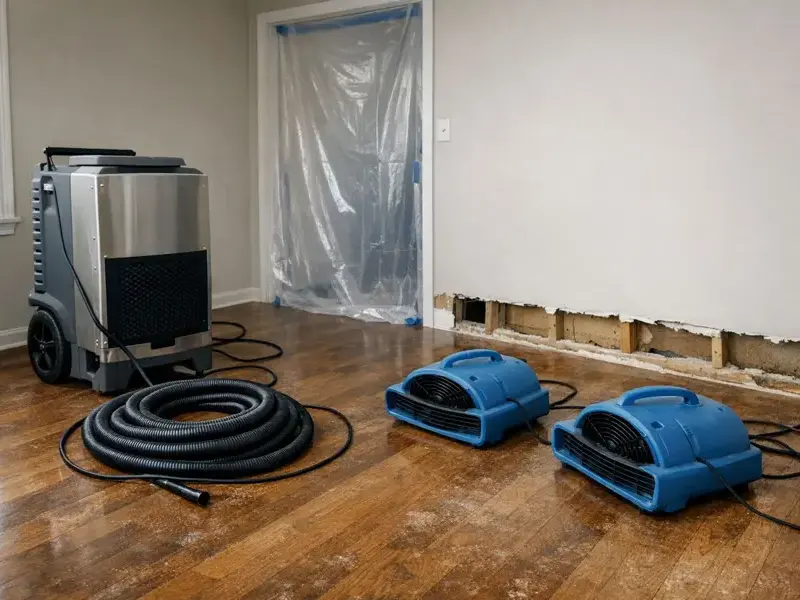
Air movers go in at the evaporation load of each room, angled along walls and into opened cavities to push moisture off wet surfaces. LGR dehumidifiers pull that moisture back out of the air; desiccant units take over for Class 4 materials and cool, damp spaces like crawl spaces. In a Decatur summer, outdoor air is often wetter than the air inside, so the drying team keeps the space closed and lets the dehumidifiers do the work.
Trade fact: equipment stays until the readings say dry, not until it looks dry. The drying goal is wet material reading within 2 to 4 points of the dry reference material in the same building.
Daily readings and the claim file
Most crews record temperature, relative humidity and grains per pound inside and outside the containment every day, along with material readings at every marked point. Those psychrometric logs show the drying is working and form the core of the insurance claim file. The EPA mold and moisture pages explain why drying within 24 to 48 hours matters, and the EPA indoor air quality pages cover humidity inside the home. Drying for wood floors is covered on the hardwood floor water damage page, and removal of standing water on the water extraction page.
Where the Decatur structural drying crew works
The Decatur restoration crew covers the whole city, from the Square, Oakhurst and Winnona Park to North Decatur and Medlock Park, and south through Belvedere Park, Candler-McAfee, Panthersville and the Snapfinger corridor.
See every neighborhood and ZIP codeRelated water damage services in Decatur
Structural Drying and Dehumidification questions in Decatur
Short answers to what Decatur homeowners ask most about structural drying.
Talk through the damage with a Decatur proWhat is structural drying?
Drying the building itself, the framing, subfloor, wall cavities and plaster, not just the surfaces you can see, to a measured moisture goal.
What is IICRC S500?
IICRC S500 is the industry drying standard for water damage restoration. It covers how a loss is inspected, categorized, dried and verified.
How does the drying team know when the house is dry?
They compare daily readings on wet materials with a dry reference material in the same house. Equipment comes out when they read within 2 to 4 points.
Can I turn the equipment off at night?
No. Air movers and dehumidifiers work around the clock; turning them off lets moisture settle back into the materials and adds days.
Why keep windows closed while drying?
Outdoor air in Decatur is often more humid than indoor air in summer. Opening windows can add moisture instead of removing it.
What is the difference between LGR and desiccant dehumidifiers?
LGR units cool air to condense water and work well in most rooms. Desiccant units absorb water chemically and work better for dense materials and cool, damp spaces.
Structural Drying and Dehumidification in Decatur? Get the drying started today.
Every hour of standing water pushes it deeper into subfloor, drywall and framing. The Decatur restoration team works around the clock.