Water Extraction & Removal in Decatur, GA
Standing water keeps moving into subfloor, baseboard and drywall until someone pulls it out. The Decatur extraction crew removes it with truck-mounted power, then dries what is left to the IICRC S500 standard.
(888) 532-4616Get water extraction started in Decatur- IICRC S500 drying standard
- Truck-mounted extraction
- 24/7 dispatch
What to do first about water extraction in Decatur
- 1
Stop the source
Close the main or the fixture valve, or get the water heater or washer shut off at its stop.
- 2
Kill wet circuits
If the breaker panel is dry and safe to reach, switch off power to rooms with standing water.
- 3
Photograph first
Take wide and close photos of every wet room before you move anything.
- 4
Lift and call
Pull rugs and small furniture off wet floors, then call for extraction.
How water extraction is handled in Decatur, GA
Every step follows the IICRC S500 drying standard, and each one leaves a record for the claim file.
- 1
Map the moisture
The tech who does the walkthrough maps moisture with pinless meters and thermal imaging before any equipment goes down, and sets the category and class of the loss.
- 2
Extract
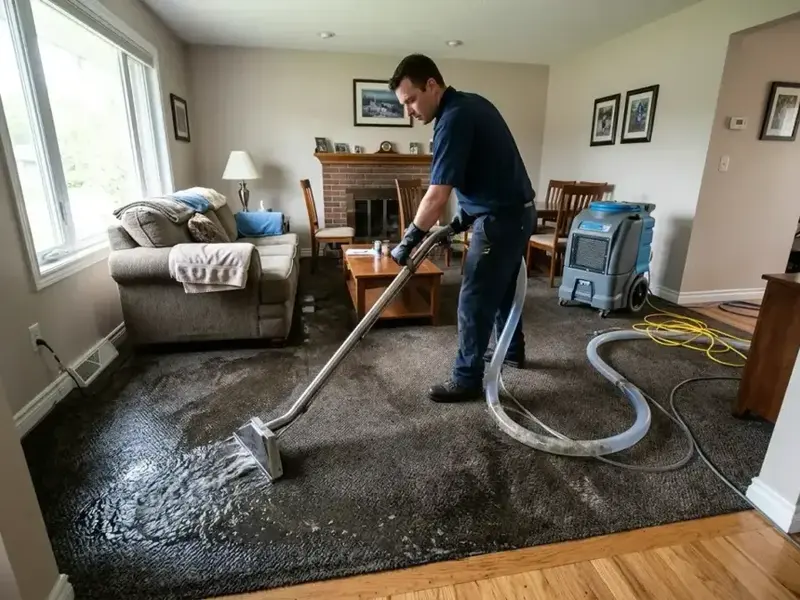
The extraction crew pulls standing water with truck-mounted extraction, so the water leaves the building instead of moving into the next room.
- 3
Dry the structure
The drying team sets air movers to each room's evaporation load and runs LGR dehumidifiers, or desiccants for Class 4 materials like heart pine and plaster.
- 4
Verify dry
Most crews pull equipment only when wet materials read within 2 to 4 points of a dry reference material in the same house, with daily readings logged for the claim file.
What does water extraction and removal cost in Decatur, GA?
In Decatur, GA, water extraction typically runs $300 to $1,500 for a contained clean-water loss and $1,500 to $4,500 when several rooms, a basement or contaminated water are involved. Drying equipment and any material removal are usually billed on top.
One room, clean water
$300 to $1,500
- Truck-mounted extraction
- Carpet and pad pressed out
- First moisture readings
Several rooms or a basement
$1,500 to $3,000
- Long hose runs and portables
- Pad pulled where needed
- Moisture map of every room
Gray or black water
$3,000 to $4,500+
- Category 2 or 3 handling
- Porous materials removed
- Antimicrobial after extraction
Ranges move with the water category, the square footage, the material class and how fast drying started. For a planning number, try the Decatur water damage cost calculator.
Extraction is the step that decides how long everything else takes. Every gallon the extraction crew pulls out as liquid is a gallon the dehumidifiers never have to pull out of the air, which is why a fast, thorough pump-out usually shortens a Decatur dry-out by days.
How the extraction crew removes standing water
Before any hose goes down, the tech who does the walkthrough maps moisture with a pinless meter and a thermal camera, because water that looks like it stopped at the doorway often runs under the baseboard and into the next room. The map sets the category of the water and the class of the loss.
- Truck-mounted units handle deep standing water and long hose runs from the curb.
- Weighted and ride-on extraction tools press water out of carpet and pad instead of skimming the surface.
- Portable units reach upstairs baths, basements and crawl-space access points.
- Pad that sat in gray or black water is pulled and bagged, not extracted and saved.
Why fast extraction matters in Decatur homes
A lot of the housing stock here works against a slow pump-out. Bungalows in Oakhurst and Winnona Park sit on crawl spaces with heart pine or oak floors that soak water up from below, and daylight basements on sloped lots let water pool against the low wall. In a humid Georgia summer, wet materials can start growing mold in 24 to 48 hours, which the EPA mold and moisture pages explain in plain terms.
Extraction is only the first step. After the water is out, the drying team moves straight into structural drying, sized to what the moisture map shows.
Trade fact: air movers and dehumidifiers do their best work after extraction. Drying a room that still holds standing water just moves the water around and stretches the job.
What to expect on an extraction call
Most crews start with the source: a shut valve, a closed supply stop or a tarp on the roof. Then the extraction crew works from the wettest area outward, photographs everything before anything is removed, and records the first readings. If the water came from a storm or a sewer, the job switches to Category 3 handling, covered on the sewage backup cleanup page. Flood safety basics from Ready.gov are worth a read before anyone walks through deep water.
Where the Decatur water extraction crew works
The Decatur restoration crew covers the whole city, from the Square, Oakhurst and Winnona Park to North Decatur and Medlock Park, and south through Belvedere Park, Candler-McAfee, Panthersville and the Snapfinger corridor.
See every neighborhood and ZIP codeRelated water damage services in Decatur
Water Extraction and Removal questions in Decatur
Short answers to what Decatur homeowners ask most about water extraction.
Talk through the damage with a Decatur proHow quickly does standing water need to come out?
As soon as possible. Water keeps wicking into drywall, baseboard and subfloor, and in humid Decatur weather mold can start in 24 to 48 hours. Extraction first, drying second.
Can wet carpet be saved after extraction?
Often, when the water was clean and the carpet was extracted early. Pad soaks up water like a sponge and is usually replaced. Carpet touched by sewage or storm water is removed.
What is truck-mounted extraction?
A powerful vacuum and pump system mounted on the service truck, with hose run into the house. It moves far more water than a shop vac and sends it out of the building.
Is a shop vac enough for a small leak?
For a small spill on a hard floor, maybe. It does not reach water under baseboards, in the pad or in the subfloor, which is where most of the damage hides.
Does extraction include drying?
Extraction removes liquid water. Drying the structure with air movers and dehumidifiers is the next phase, and equipment stays until readings say dry.
What if the water came in from a storm?
Storm and creek water is treated as Category 3. Porous materials it touched are removed, and the area gets an EPA-registered antimicrobial before drying.
Water Extraction and Removal in Decatur? Get the drying started today.
Every hour of standing water pushes it deeper into subfloor, drywall and framing. The Decatur restoration team works around the clock.